
Checking Criminal History in Valley
Start with Valley Police when the event occurred inside the city and an officer made the report. Use Douglas County Corrections for custody, JUSTICE for filed court proceedings, and the Nebraska State Patrol search for a certified statewide product. Each channel covers a different stage.
Follow the record outward from Valley:
- Write down the incident date, location, names, and report number if one was issued.
- Request the Valley Police incident or arrest report from the local custodian.
- Search Douglas County Corrections when the event involved a custodial arrest.
- Search JUSTICE for a County Court citation or charge and District Court felony case.
- Use the NSP RAP search for disseminable fingerprint-supported Nebraska history.
A name-only hit is not enough. Compare the agency, dates, court, and case or booking identifiers.
Valley Records at 203 Spruce
Valley Police shares the City Hall complex at 203 North Spruce Street, Valley, NE 68064. The department publishes 402-359-2251 extension 308 and fax 402-359-2610. That shared location makes the local counter a practical first stop when a requester is unsure whether Police or another city custodian holds the item.
The official Valley Police page shows the department's local contact point.
The image confirms the city source used for the local office profile. Ask which custodian owns the record before sending a broad request.
Valley Police Department Records
Valley Police maintains reports made by its officers. The department emphasizes neighborhood policing, National Night Out, partnerships with schools and businesses, and specialized training related to domestic violence and child abuse. Those duties can create reports with protected victim or juvenile facts that are not released in full.
A written request should identify the date, location, people involved, and report number, then state whether inspection or an electronic copy is preferred. No current official Valley police-report fee schedule or detailed form inventory was found in the research. Confirm cost and release requirements with the custodian rather than assuming a fee.
The event report stays local even if a detention, prosecution, or fingerprint record later appears in a county or state system.
Valley App Is Not a Record Search
Valley advertises a municipal app for alerts and city information. The inspected official description did not establish an app-only warrant, inmate, or police-report database. Treat the app as a communication channel unless its current listing expressly provides a records tool.
This distinction prevents a common dead end. An alert about city activity is not the underlying incident report. A requester still needs Valley Police for the report, Douglas County Corrections for a booking, and JUSTICE for filed charges. Do not infer that a missing app item means no record exists.
App functions can change. Use the City Hall number to confirm the current route when a menu label is unclear.
Valley Arrests and Bookings
Valley does not operate the county jail. A custodial arrest travels to Douglas County Corrections in Omaha. Corrections creates the booking record, fingerprints, custody status, charge or hold labels, and bond or release fields where public. Valley Police retains the event narrative.
Search Corrections first for a very recent detention. Then request the Valley report and look in JUSTICE after the expected entry lag. A jail label reflects the basis known at intake and can differ from the complaint later filed by the County Attorney. The court disposition controls the case outcome.
Note: Valley Police, Douglas County Corrections, and the court clerk are three custodians, even when their records describe one event.
Valley Arrests Travel to Omaha
The city report begins at 203 North Spruce, but booking and court records are maintained in Omaha. Douglas County Corrections is at 710 South 17th Street. Douglas County Court and District Court use the Hall of Justice at 1701 Farnam Street. That distance does not create a separate Valley justice system.
For a recent arrest, note the booking identifier before seeking the court case. County Court hears misdemeanors, ordinance citations, traffic cases, and felony preliminary proceedings. District Court hears filed felony trials. A felony can therefore appear at both court levels under linked but distinct case records.
The countywide detail belongs in the Douglas County criminal court cases resource. Valley's role remains the local incident and police-report custodian.
Municipal Court Records in Valley
Valley has no separate municipal trial-court database. Douglas County Court's Criminal/Traffic Division records city citations, ordinance cases, misdemeanors, traffic matters, and felony preliminary proceedings. Search the statewide JUSTICE service or ask the County Court clerk for a known file.
| Court Name | Douglas County Court, Criminal/Traffic Division |
|---|---|
| Case Types Heard | Valley ordinance cases, misdemeanors, traffic, and felony preliminary proceedings |
| Case Lookup Channel | JUSTICE, courthouse kiosk, or clerk at 1701 Farnam Street |
| What the Docket Shows | Parties, filed counts, hearings, orders, dispositions, sentence, and costs |
| Copies & Fees | Confirm current copy or certification charges with the clerk |
Valley Patrol Forms Differ from Reports
Valley's official FAQ mentions a vacation-patrol request and a local curfew. Those city services can create administrative records, but a vacation-patrol form is not a criminal incident report. The distinction matters when someone asks City Hall for “all police records” tied to an address.
The Valley police FAQ source provides the local service context.
The image supports a simple request rule: name the form, report, date, and event instead of using a broad label that joins unrelated city files.
Where Valley Records Go
Valley Police makes the local report. Douglas Corrections makes a booking record after detention. The County Attorney decides what to charge, and a Douglas court records the case. Fingerprint-supported arrest cycles and dispositions then reach the Patrol Criminal History database.
Record flow: Valley Police Department › Douglas County Courts › Nebraska State Patrol Criminal Identification Division
A recent event belongs first with Valley Police or Corrections. A filed matter appears through JUSTICE. The NSP certified product answers a broader Nebraska question. Differences among them may reflect timing, identity matching, or public-dissemination rules.
When Valley Records Are Not Online
No comprehensive Valley arrest blotter or report database was established in the research. That makes the written request a main channel, not a last resort. Address it to the City Clerk or Police custodian and include the date, place, case number, names, record type, and preferred electronic format.
Ask to inspect when the volume is unknown. Request a cost estimate before copies are made. If protected information is mixed with public text, ask for the segregable public portion. If access is denied, request the reason and statutory basis in writing.
Do not guess at a report fee. Valley's current official fee and form inventory were not found, so the city should confirm them for the particular request.
A useful written request says whether the requester wants to inspect, receive an electronic copy, or obtain a certified copy. It can also ask for an estimate before costs exceed a stated amount. That gives the custodian a clear scope without forcing staff to infer which of several records tied to an incident is wanted.
When the event includes 911 audio, dispatch data, body-camera material, or a crash investigation, list each item separately. Those formats may require their own review for victim privacy, medical facts, juvenile information, or facts that could affect an open investigation. A partial redaction does not turn the remaining public portion into a different record.
If Valley Police says another agency made the record, note that agency and redirect the request. A State Patrol highway arrest, Douglas sheriff event, or joint investigation does not become a Valley Police report merely because it occurred near the city. The creating agency is usually the best first custodian.
From Valley Fingerprints to NSP
A qualifying custodial arrest creates fingerprints and an arrest cycle that can flow to the Nebraska State Patrol Criminal Identification Division. A prosecutor and court later report the outcome. If those steps have not yet matched, a police report, booking record, JUSTICE case, and NSP RAP result can differ.
The $30 NSP Limited Criminal History Search is nonrefundable and requires first name, last name, date of birth, sex, and race. It is not the same as a Valley Police report. It covers disseminable, fingerprint-supported Nebraska arrest and prosecution history under state law.
- Arrest cycle
- The repository's linked arrest, charge, and disposition group.
- Disposition
- The outcome of a count, such as dismissal, acquittal, or conviction.
- Booking
- The jail intake process that creates custody identifiers and fingerprints.
Valley Neighborhood Records Context
Valley's neighborhood-policing model shapes the kinds of city records a resident may encounter. National Night Out work, school and business partnerships, vacation-patrol requests, and local alerts can produce administrative contacts that are not arrests or criminal cases. Keep those categories separate when requesting records tied to a person or address.
A police contact can generate a call or incident number without producing a booking. A booking can occur without the prosecutor filing the same charge. A filed case can end in dismissal or acquittal. The record label and its custodian show which stage has actually occurred.
This small-city context is also why a broad Douglas County name search may miss the most useful first document. Valley Police can identify the event report, Corrections can confirm detention, and the clerk can verify a filed outcome. Moving in that order preserves the local facts while avoiding assumptions based on Omaha-scale data.
Public Access Rules in Valley
Nebraska's public-record law generally opens city records during normal business hours. It also permits lawful protection of active investigative details, informants, complainants, juveniles, victims, medical data, private identifiers, and sealed records. A precise request helps Valley staff separate public material.
The four-business-day rule does not promise final delivery in four days. If the record cannot be produced in that time, the custodian must send a written explanation with an estimated completion date and cost.
The official Nebraska access statute is also the source of the page image below.
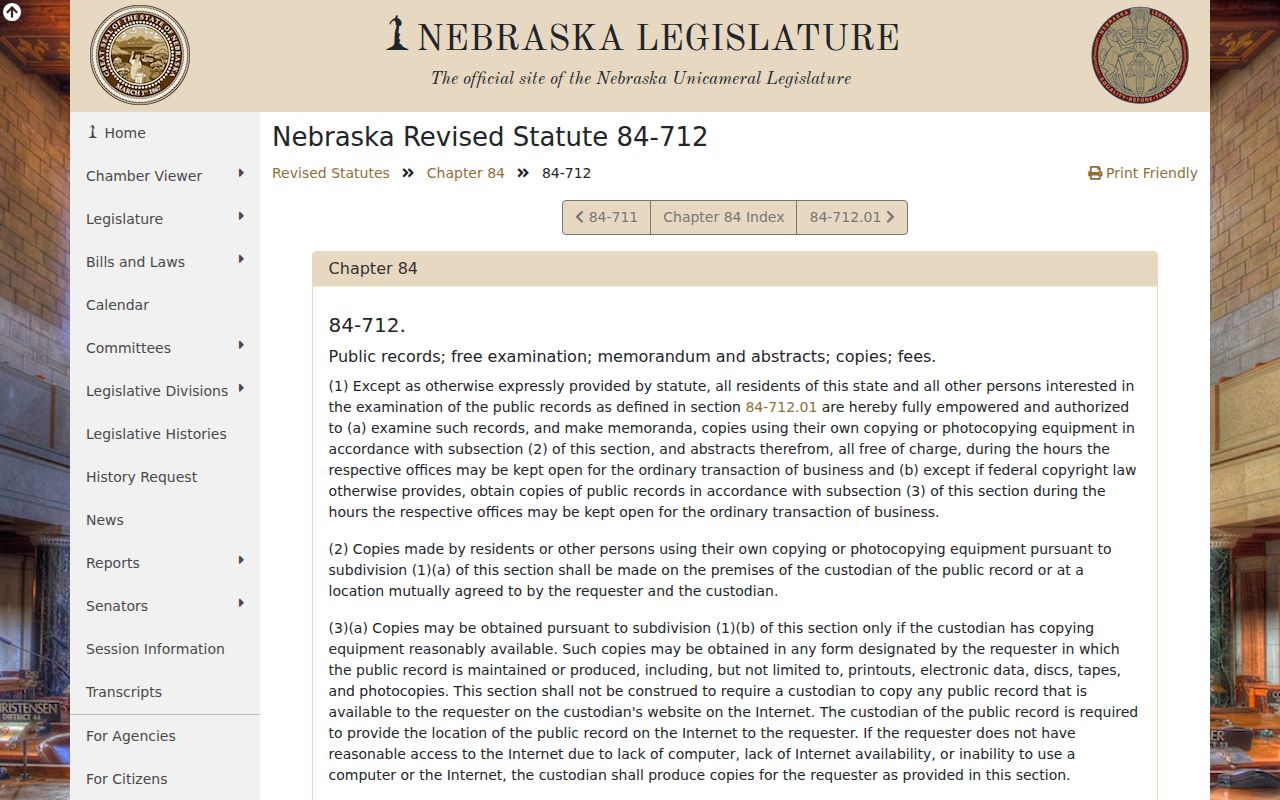
The statute image ties Valley's local request process to the statewide right of inspection and copying, subject to defined limits.
Key Statutes:
Neb. Rev. Stat. §84-712 gives the general inspection and copying right.
Neb. Rev. Stat. §84-712.05 permits withholding of listed sensitive material.
Neb. Rev. Stat. §29-3523 limits public release of qualifying non-conviction history.
Public access is not the same as full disclosure. Ask for nonexempt parts and preserve the written response when a limit applies.
Non-conviction dissemination is a separate issue from obtaining a Valley police report. Section 29-3523 provides removal schedules for qualifying outcomes in the public criminal-history product. A court file and the NSP RAP system do not always change at once. Review both sources after a dismissal, acquittal, or other eligible result.
If an NSP record lacks the final outcome, contact the Criminal Identification Division at 402-479-4971 with the court case number and order. Staff may need to match the disposition to the correct fingerprint arrest cycle. Preserve the Valley report number, booking identifier, and court number because those links are more useful than a broad name search.